
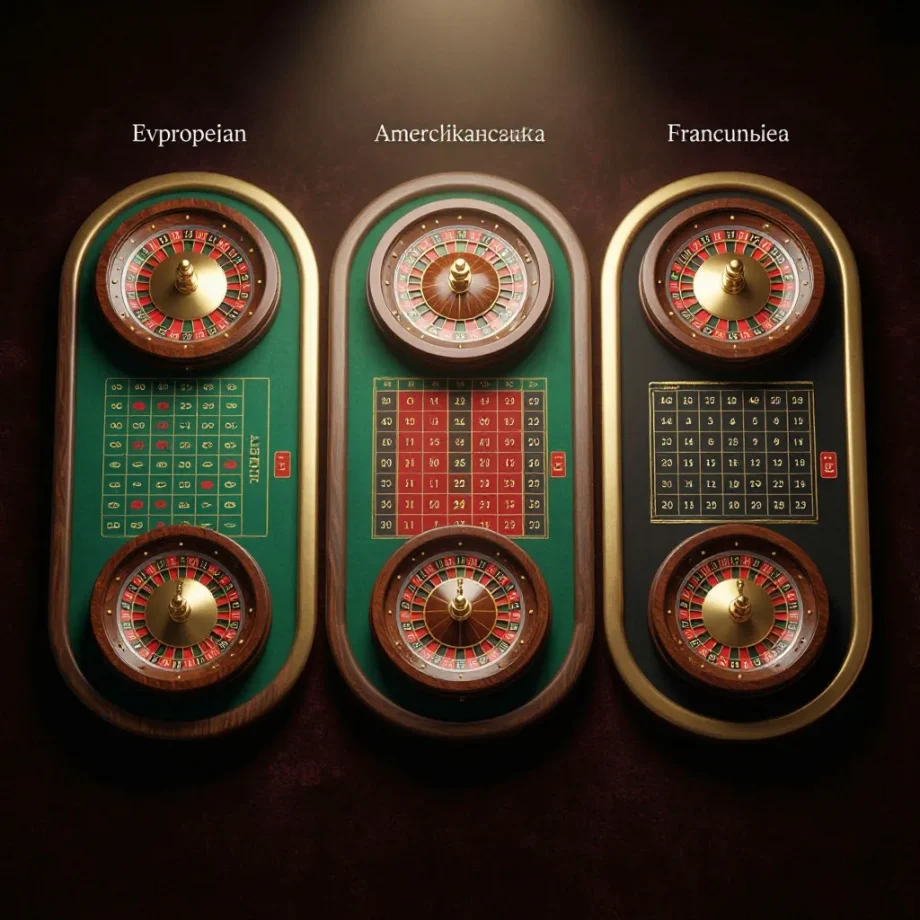
Roulette has the unusual distinction of being one game and, simultaneously, three games with three different prices. The wheel looks almost the same on every floor — spinning numbers, a bouncing ball, the same betting layout — but depending on which variant you sit at, the same bet costs you more than double what it costs elsewhere. A single-zero wheel takes 2.7% of everything you wager over time. The double-zero American version takes 5.26%. And the French game, with one quiet rule that most players never learn, cuts the single-zero cost nearly in half.
None of this information is hidden. The number of pockets is visible on every wheel, and the special rules are printed on the layout in French words that most players walk past without reading. Yet surveys of player behavior consistently show that a large share of roulette players cannot name the house edge of the game they are playing, and a meaningful share sit at American wheels while single-zero tables stand open nearby. The mathematics of roulette is simple enough to explain completely in one article, and the difference between knowing it and not knowing it is, over a lifetime of play, one of the largest sums of money in gambling.
The one number that separates the variants
The entire house edge difference between roulette variants comes from a single design detail: the number of zero pockets. Zeros are the casino’s territory — they belong to no outside bet, no color, no dozen — and every zero that lands, every outside bet loses. The European wheel has one zero among 37 pockets; the American wheel has two among 38, because it adds a double-zero pocket alongside the standard zero. That single pocket is the entire difference between 2.7% and 5.26%, and the comparison below shows how it propagates through every bet on the layout:
| Bet type | European (single zero) | American (double zero) | French (single zero + la partage) |
|---|---|---|---|
| Straight up (single number) | Pays 35:1, edge 2.70% | Pays 35:1, edge 5.26% | Pays 35:1, edge 2.70% |
| Red/black, odd/even | Edge 2.70% | Edge 5.26% | Edge 1.35% (la partage) |
| Dozens, columns | Edge 2.70% | Edge 5.26% | Edge 2.70% (except even-money) |
| Column bet edge comparison | 2.70% | 5.26% | 2.70% |
| Five-number bet | Not available | Edge 7.89% — worst bet on any wheel | Not available |
| Expected loss per 100 units wagered | 2.7 units | 5.26 units | 1.35 units on even-money bets |
The French column in this comparison is deliberately selective, and the selectivity is the point: the la partage rule applies only to even-money bets — red, black, odd, even, high, low. On those bets, when the ball lands on zero, the casino does not take the full stake; it takes half, or holds the stake for the next spin under the alternative en prison rule. That single concession cuts the effective edge on half the layout from 2.70% to 1.35% — the lowest house edge of any standard roulette bet in existence. Dozens and columns on the French wheel still cost the full 2.7%, which is why the French game is not automatically cheaper in every configuration, only in the most common one.
Why one pocket doubles the price
The American wheel’s fifth-percentage-point premium is worth understanding as arithmetic rather than accepting as a fact, because the mechanism behind it appears across the entire gambling industry. The double-zero wheel pays its bets exactly like the single-zero wheel: a straight number still pays 35:1, even-money bets still pay 1:1. But the wheel now has 38 pockets instead of 37, so the probability of every winning outcome is lower while the payouts stayed the same. The gap between what the payouts assume (37 pockets) and what the wheel delivers (38 pockets) is pure house profit — one pocket’s worth of margin, roughly doubling the edge.
This is also why the notorious five-number bet on the American layout deserves its reputation. The bet covers 0, 00, 1, 2 and 3, pays 6:1, and carries an edge of 7.89% — the worst standard wager on any roulette wheel anywhere. There is no strategic justification for it, no system that redeems it, and no variant where it appears in better form; its existence is a pure tax on players who did not compare prices before sitting down.
The French rules: two words that halve the edge
La partage and en prison are the two most valuable words in roulette, and they are usually written in small type along the edge of the layout. The two rules are variations of the same concession applied to even-money bets when zero lands:
- La partage — the casino returns half of your even-money stake immediately; the bet is settled, you keep half, and the round ends;
- En prison — the casino locks your even-money stake (“imprisons” it) for the next spin; if the new spin wins, your original stake returns intact; if it loses, the stake goes to the house.
The two rules are mathematically nearly identical in effect — each reduces the even-money edge from 2.70% to about 1.35% — though en prison introduces a small difference depending on how ties are handled on subsequent zeros. European wheels in some regions adopt one of these rules as well, particularly in the United Kingdom and in online versions labeled “European with la partage.” The presence or absence of these rules is not always signposted loudly, so the practical skill is asking before playing: a one-line question to the dealer or a check of the game’s information panel settles the entire pricing question in seconds.
Reading a table from a distance
Identifying the cheap tables before sitting down is a physical skill in live casinos and a screen-reading skill online. The tells are consistent and easy to learn:
- Count the zeros on the wheel head — the definitive method; one green pocket means single-zero pricing, two green pockets mean the full 5.26% premium;
- Check the layout for a double-zero position — American layouts carry 00 alongside 0, and the presence of the five-number betting area confirms the variant;
- Look for la partage or en prison printed on the layout — French tables display the terms along the outside edge; online versions state the rules in the game information panel;
- Ask the dealer or read the rules tab — in live dealer games online, the rules screen lists the exact zero rules and their application; ten seconds there is worth more than any strategy discussion;
- Compare minimum bets across tables — single-zero tables sometimes carry higher minimums; the price comparison must weigh the edge against the minimum, since a cheaper edge at a minimum you cannot sustain is not actually cheaper.
The fifth point introduces the one genuine trade-off in variant selection: French single-zero tables, particularly in physical casinos, often run higher minimum bets and a slower, more formal pace. For a small bankroll, the 2.7% European table at a low minimum may represent better real-world value than a 1.35% French table whose minimum would exhaust the budget in a handful of spins. Edge is a percentage; budget is a number; the optimal seat sits where both are satisfied.
Betting systems and the edge: the uncomfortable truth
No roulette variant is bested by a betting system, and the house edge numbers above explain why with unusual clarity. Every system — Martingale, D’Alembert, Fibonacci, flat progression — changes the distribution of outcomes without changing their sum. Doubling after losses does not alter the probability of any spin; it alters how the same expected loss is distributed across the session. The player who doubles relentlessly converts many small losses into occasional large ones; the player who bets flat converts the same edge into a smoother, slower decline. The expected cost of both approaches, per unit wagered, is identical — the percentages in the comparison table do not move for anyone.
The one legitimate refinement within the variant framework is bet selection: on a French table, playing even-money bets captures the full 1.35% edge, while playing dozens surrenders half the advantage back to the 2.70% baseline. That choice — where on the layout to place the same money — is the only decision in roulette that changes the price you pay, and it is a decision about variant and layout, not about prediction.
The practical verdict: where the cheapest roulette lives
The ranking that emerges from the numbers is unambiguous. The best standard roulette in existence is a French table with la partage or en prison active on even-money bets: an edge of 1.35%, half the European baseline and a quarter of the American cost. The second-best is a standard European single-zero wheel at 2.70% — the industry’s reliable default, and in online casinos the most widely available good option. The American double-zero wheel, at 5.26%, is a variant to recognize and avoid whenever any alternative exists — and its five-number bet, at 7.89%, is the single worst spot on any layout in the game.
What the numbers ultimately teach is that roulette’s fairness was never a matter of luck, superstition or betting patterns — it was always a matter of zeros, rules and the small print on the layout. The players who lose least at this game are not the ones with the best systems; they are the ones who counted the pockets, read the French words at the edge of the felt, and asked one question before placing a single chip. The wheel does not change for anyone — but which wheel you choose is entirely, permanently, and mathematically your own decision.